
















What makes an assembly meaningful versus inconsequential? Students and teachers both agree that it is not the topic that makes the assembly, but rather the speaker. Engagement from students can make or break an assembly and can affect what a student takes away from a speaker’s presentation.
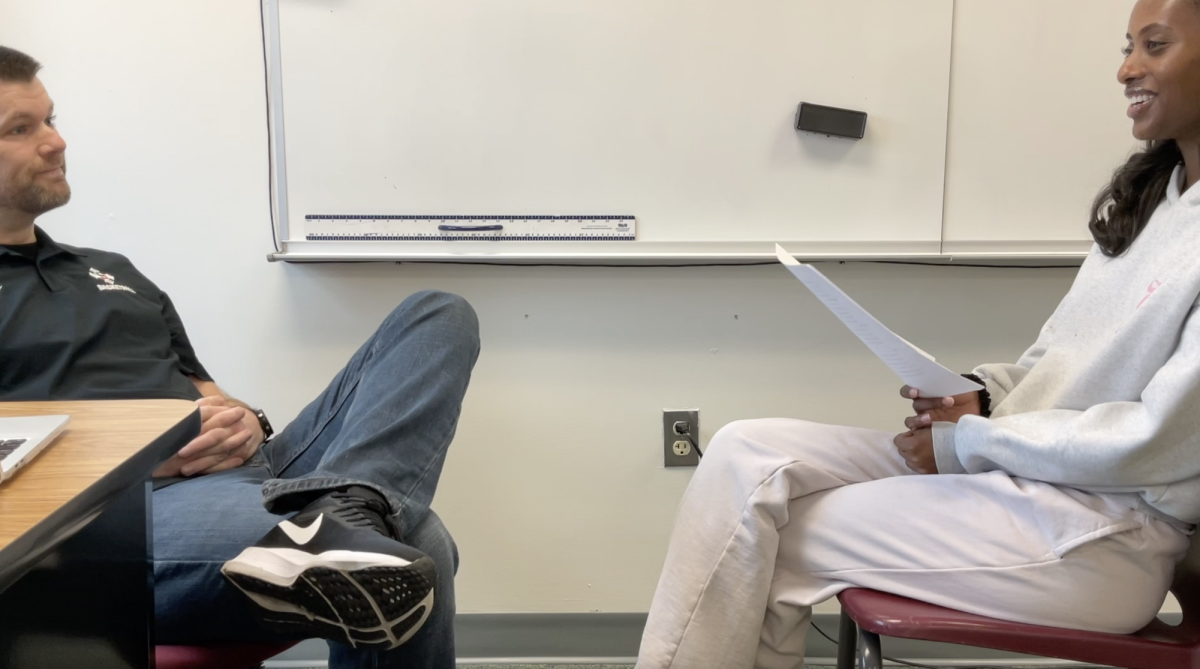
To ensure that the assembly is a positive experience for students and teachers, Upper School Dean of Students, Ms. McGuire, has a careful process to select a speaker. Ms. McGuire admits that there has been “a few misses over the years,” but she states “I am really careful to make sure that I have seen them on YouTube and that I talk to other schools to make sure that they’re gonna be engaging and interesting and also are going to have the same sort of message that we would want to have.”
The Director of the Upper School Mr. Mallett adds on by saying that picking the speaker “Is in partnership with our alumni office or perhaps Mrs. Adams has an idea or it’s someone from the APT who has an idea of an impact speaker.”
Together this group of faculty members works extremely hard behind the scenes to make St. Stephen’s and St. Agnes School assemblies a success.
During the school year SSSAS hosts many assemblies, some of these happen yearly, like the honor codes Assembly, Convocation, and Veterans Day, while others are based on student requests or interest in a topic. Over the years the school has had many topics that students had been interested in ranging from effects of vaping to, more recently, consent.
Ms. McGuire said that “consent is something everyone is interested in. I mean, I will say probably more of our folks that identify as girls than boys, but consent is a particular passion of mine.” In years past the school has brought in Chessy Prout and her father to speak about consent at an assembly. Chessy Prout was a victim of rape who has made it her life mission to speak out against dating violence.
Madison Hughes 26’ says that the consent assembly “was really amazing. I feel like it opened a bunch of people’s eyes.”
In a student’s perspective it is not just about who is speaking in an assembly and what they are speaking on, but how a speaker engages with the students is equally as important.
Hannah Jakupovic ‘28 says she “really liked the honor code assembly because the speaker was very good at engaging the students and it wasn’t boring. I also like the way he spoke and the energy he gave to the students.”
Ironically, Madison Hughes ‘26 said that “this year, I wasn’t a big fan of the honor code assembly, it pretty much sucked.”
While energetic, the Hispanic Heritage Month assembly speaker Gabriel Ramirez had mixed reviews. The Cranford advisory discussed how the speaker was not very informative about Hispanic Heritage Month and its history. Instead he focused mostly on his own personal experiences throughout his life. He did use Spanish words in his poems and made references to his heritage and how it affected his life, however he did not generalize those struggles to the greater Hispanic community. The advisory did appreciate the speaker’s energy and how hard he worked to engage the audience. Things like asking students to snap if they resonated with something he was saying or chanting a part of the poem with him made for a more positive experience for students.
Assemblies serve as a time for the community to come together to learn and listen about a topic or issue. While students’ perspectives on an assembly can be determined by many factors and not all students will enjoy an assembly, Mr Mallet stated “it’s an opportunity to come together as a community and for the students to hear the same message. And so if you talk to a freshman, you guys knew that you sat there in that same moment, right? and heard those things. So I think it’s because of the shared experience in nature. I think that’s why assemblies are important.”