










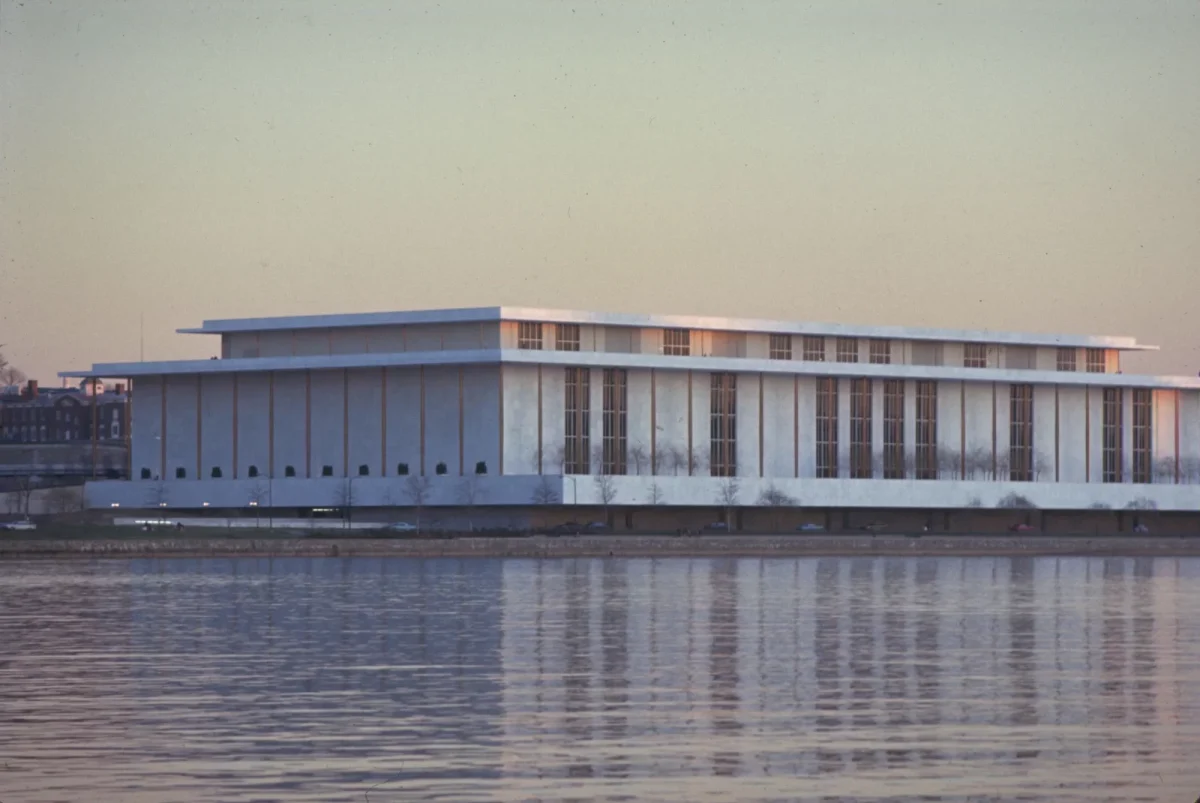
The John F. Kennedy Center for the Performing Arts has served as the cultural pulse of Washington, D.C. for over half a century. For many students at St. Stephen’s and St. Agnes School, its proximity has made it a second classroom for learning about music, dance, and theater. However, this relationship has been abruptly severed. In late January, President Trump announced a two-year, $200 million renovation of the center, labeled by the administration as a project that would transform “a tired, broken, and dilapidated center,” into “the finest Performing Arts Facility of its kind.”
This move comes amid what many describe as a complete overhaul of federal institutions during the opening months of Trump’s second term. After removing the bipartisan board of Biden appointees and installing himself as the new chairman, Trump moved to permanently change the identity of the center. The landmark, which was originally a memorial for the late president John F. Kennedy, has been rebranded as “The Donald J. Trump and John F. Kennedy Center for the Performing Arts” (litigation regarding the legality of the name change is ongoing, and The Voice will continue to refer to it by its congressionally authorized name).
Unsurprisingly, the fallout has been immediate. As many world-renowned artists have canceled performances in protest of the center’s politicalization, the SSSAS community has been forced to deal with the loss of a local treasure.
Discussing her reaction to the news of the center’s closure, senior Janney Cooper explained that she “was very disappointed, but honestly, not too surprised, because I know that attendance at recent performances and shows has been greatly lowered… I was definitely very disheartened when I found out, because I think the Kennedy Center is just such a pinnacle of performing arts in our country, and a symbol of hope and community.”
After taking control of the center, Trump claimed that “we ended the woke political programing and we’re restoring the Kennedy Center as the premier venue for performing arts”
Dr. Criswell, upper school performing arts teacher and orchestra director, explained how “The Kennedy Center was always open to bipartisanship. It was a bipartisan thing. I’ve attended performances where I saw people in the other party that I’m not a part of in attendance. So the arts at the Kennedy Center have always been a bipartisan entity. It was never a partisan thing. And as soon as the name change happened, then it became extremely politicized.”
Ticket sales have been hit hard as theatergoers in the DC region have begun to avoid Trump’s version of the Kennedy Center, decreasing 50% after his takeover and installation as chairman, according to data reviewed by The New York Times.
Janney elaborated on the significance of the 54-year old institution to her, noting how, “around this time last year, I went there to see a ballet depiction of the Lunar New Year with my Taiwanese exchange student, and I’ve seen so many other productions through school and other events as well.”
Two months after President Kennedy’s assasination in 1964, Congress named the center after him as a way to honor his support for the performing arts. Sophomore Copper Spies discussed the meaning of that name to him, explaining that “it’s a really cool place. It’s a really cool way to honor John F. Kennedy… because he was one of the better presidents.”
SSSAS student groups have traveled to the Kennedy Center to view performing art productions for years. In a statement to The Voice, Lower School music teacher Mrs. Gelhoff explained that “students have enjoyed attending performances at the Kennedy Center for decades. With the planned renovations causing a two year closure, our off campus opportunities will certainly be more limited, but music-making and music learning will continue.”
Dr. Criswell, upper school performing arts teacher and orchestra director, shared that he first led an upper school student group to the Kennedy Center in 2009, when he went with the orchestra to perform at an event in The Terrace Theater. Dr. Criswell has also conducted at the Cappies gala, an annual event celebrating high school performing arts in the DMV which was previously hosted at the Kennedy Center.
Mrs. Gehlhoff shared her plans to continue supporting other local performing art organizations, including the National Symphony Orchestra, Washington National Opera, and the Kennedy Center Theater for Young Audiences. Previously located in the Kennedy Center, these organizations will be in alternative venues while the Kennedy Center is renovated. Mrs. Gehlhoff also expressed an interest in options located outside of the Kennedy Center..
Senior Lindsay Parsont shared her view that the administration is “distracting from actual issues going on,” saying, “they do all this stuff politically, and then they start doing a bunch of random things that most presidents haven’t touched before. So it’s kind of like, look at this stuff, don’t look at the actual bad stuff that I’m doing. They’re kind of just throwing everyone for a loop, in my opinion, because you can’t keep up with all the stuff that they’re doing.”
Dr. Criswell noted that “by closing it, and regardless of what they do renovation wise, they don’t have to admit that there are problems that have been created that did not exist before this.”
The changes made at the Kennedy Center are just one element of what has become a sweeping overhaul of how the federal government supports the arts under the direction of the new administration. On his first day back in office, Trump terminated the President’s Committee on the Arts and Humanities. Shortly after, his administration began eliminating grants given through the National Endowment for the Arts, ending critical financial support for artistic productions across the country.
Projects that have maintained funding have been closely aligned with the president’s own agenda. Trump has heralded a handful of new large-scale artistic project proposals in Washington, namely a $40 million dollar “National Garden of American Heros,” and a potentially over $100 million, 250-foot triumphal arc at Arlington National Cemetery, according to Axios.
“It seems like the current administration is maybe prioritized more with, at least from my perspective, putting their name on the arts and kind of presenting themselves as being patrons of the arts, without maybe really putting in the time the dedication to actually care for the arts and make them a priority in the country,” said Janney.
Concluding with her thoughts on the future of the Kennedy Center, Janney said, “I just hope that in future years, some of its glory and just public reputation can be restored and that it can open again.”